Setup sheets can be useful.
There. I said it.
If you’ve been racing RC cars for any amount of time, you’ve probably done it. A fast driver posts a setup sheet from a big race, you download it, stare at the numbers, and start comparing it to your car.
Maybe you start changing things. Maybe you start changing things you have never considered or looked at before.
After all, this setup was fast.
The problem is that a setup sheet usually tells you what was on the car when someone decided to write it down.
It rarely tells you why.
And the why is where most of the useful information lives.
What Problem Was This Setup Solving?
This is probably my biggest grievance with setup sheets.
They usually contain a lot of measurements and very little context.
Imagine seeing a 1mm shim, where the kit and instructions show a 2mm shim.
Okay.
Why?
Bump-steer? That wasn’t included in the manual… Why did they go to 1mm instead of 3mm? Link angles? I had to take High School Geometry twice!
Or did the driver accidentally change it three practice sessions ago, the car got faster, and they never touched it again?
All stories produce the exact same number on a setup sheet.
Without knowing the expected behavior, the actual behavior, and the reason for the change, you’re missing most of the experiment.
A setup sheet gives you the answer without showing the work.
It can be useful. It can also be seriously misleading.
How Did the Driver Want the Car to Feel?
This gets ignored constantly.
Drivers do not want the same car.
Some drivers want a car that rotates aggressively the instant they lift. Others want something planted that they can carry through a corner. Some want enormous steering response. Others want a calmer car that lets them make smaller corrections and use the whole wheel.
Neither is necessarily wrong.
The setup exists partially to make the car behave correctly for the person holding the radio.
That means copying another driver’s setup without understanding their driving style can create a car that is objectively fast and completely miserable for you to drive.
This is especially important when looking at setups from extremely fast drivers.
They may be comfortable controlling something you aren’t.
Or, just as importantly, you may be comfortable controlling something they aren’t.
I care much more about whether I can predict what the car is going to do than whether my setup sheet looks like the one belonging to the fastest person in the building.
Where Did the Setup Start?
This might be the information I want most, and it almost never exists.
Show me Version 1.
Then show me Version 2.
Then tell me:
“The car had too much rotation entering the corner, so we changed X.”
Now we’re getting somewhere.
Then:
“That fixed entry, but now the car wouldn’t finish the corner, so we changed Y.”
Beautiful.
Now I’m learning something.
Eventually you arrive at the setup sheet everyone sees.
But the final setup isn't necessarily the interesting part.
The path to the setup is.
That evolution teaches you what each change actually did on that car, on that surface, with those tires, under those conditions, for that driver.
More importantly, it teaches you how someone thought about the car.
That information is dramatically more transferable than knowing they ran 0.6 mm of rear droop.
The bread crumbs are much more interesting than the sandwich, when it comes to setup.
There Are a Lot of Blanks
Even a detailed setup sheet can't capture everything affecting the car.
How were the tires prepared?
How old were they?
What was the track grip like?
And when, exactly, was this setup recorded?
Was this the setup from the first day of practice, when the track was completely green and everyone was searching for grip?
Or was this written down after A3, after a thousand-plus laps had been put on the track and the surface was high-grip, driven-in, and behaving completely differently?
Those could require two very different cars.
A change that made perfect sense Friday morning might be exactly the thing you remove Saturday night because the track came up.
And if all I have is the final number on the sheet, I have no idea which condition that number was solving.
Was the setup from qualifying or the main?
Did grip increase throughout the weekend?
Was something changed because the car needed it, or because the track changed?
Was the driver testing something?
Was the car actually good?
That last one sounds stupid, but it matters.
A setup sheet from a fast driver doesn't necessarily mean the setup was perfect. Maybe they hated the car and were simply talented enough to drive around the problem.
The result tells you how fast the combination of car + driver + track condition went.
It doesn't necessarily tell you how good the car was.
And Then There’s the Stuff That Isn't On the Sheet
This is where things get particularly messy.
Setup sheets usually do a good job documenting the manufacturer's adjustable components.
They aren't always as good at documenting everything else.
Maybe there's an aftermarket part.
Maybe something has been modified.
Maybe there's a part from another manufacturer.
Maybe there's a different wheel, bearing, servo, body mounting arrangement, tire preparation method, electronics configuration, or some tiny modification that doesn't have a convenient little box on the setup sheet.
Sometimes those things don't matter.
Sometimes they matter a lot.
I'm not suggesting people are deliberately hiding things. A setup sheet is just a form, and forms record the things somebody decided were important when the form was created.
Real race cars have an annoying habit of being more complicated than forms.
So when I see a setup sheet with every box neatly filled in, I don't assume I'm looking at a complete description of the car.
I'm looking at the things that fit on the sheet.
So Are Setup Sheets Useless?
Absolutely not.
I use them.
They're fantastic for establishing a reasonable starting point. They're especially valuable when you're unfamiliar with a platform and need to know roughly where the setup window is.
If multiple drivers are all somewhere around the same zip code, that's useful information.
It tells me where to start.
What it doesn't tell me is where I should finish.
That's the distinction.
I don't want to copy somebody else's setup and spend the rest of the day trying to convince myself that I should like it because they're faster than me.
I want to understand what my car is doing. Then I want to make a change for a reason. Drive it. Feel what changed. Decide whether that moved the car in the direction I wanted. Then do it again.
Because eventually something much more useful happens:
You stop asking,
“What setup are the fast guys running?”
and start asking,
“What is my car asking me for?”
A setup sheet can help you start that conversation.
It just can't have the conversation for you.
So now that my rant is over…
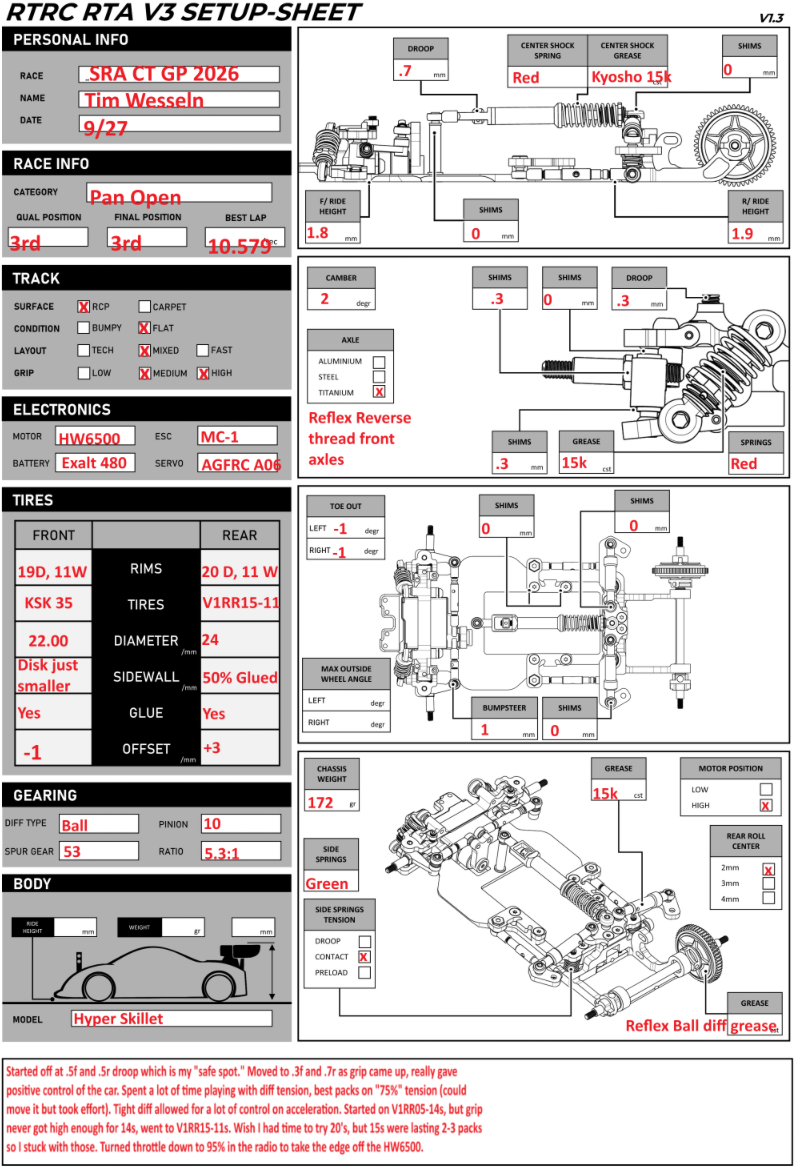
I present to you my Open Pan setup sheet from the SRA Finals CT GP.
I’m very proud of it. I was able to get faster all weekend long. My 10.5 hot lap was an amazing personal accomplishment. After breaking into the 10’s early in the weekend, I moved the goalposts back to a 10.5, and I was able to make it happen.
Because after four years in the hobby, I think I’m finally turning a corner in my driving. I’m no longer blindly imposing my will on the car. I’m trying to listen to what it is asking for.
Fin.